
I would like to present the idea that popular opinion can influence rigorous scientific study into a field we would normally call completely nuts-crazy-bonkers. In other words, pop-culture creates much of tomorrow’s obsolete science.
Remember when Ghost Busters the movie spawned a generation seduced by the paranormal? I grew up with ‘Are You Afraid Of The Dark’ and R.L. Stein then graduated to the X-files and countless others. As Ghost Buster’s was being screened, scientists packed labs to create hand held devices to measure electric fields and thermal video cameras that eventually took centre stage in reality TV shows.
Still not convinced? Today we are obsessed with Zombies. Their spotlight includes entire franchises like Resident Evil and 28 Days Later. Recently, a team of mathematicians published a paper on the survivability of a true zombie attack (1).
But has this always been the way? Is this a new trend or is history just repeating itself? I’d like to take this opportunity to introduce you to my personal hero, Linus Pauling. Not simply because he is the most awesome person who ever loosely resembled Yoda; I feel his career demonstrates how pop-culture influence scientific direction.
Linus is the only person to ever win two unshared Nobel Prizes, and if you didn’t already know, he won them in two very different categories. In 1954 he won the Nobel Prize for Chemistry and in 1964 he won the Nobel Prize for Peace. Awards and accolades aside, Linus spent much of his time applying his scientific rigour to the pop-culture problem of the day. Today, we leave the very same topics to people wearing tinfoil hats.
In 1963 when John F. Kennedy was made cranially porous, Linus became consumed in the mass hysteria that accompanied the very public assassination. He began collecting as much information as he could about the incident. He amassed such a vast quantity of information on possible conspiracies; the Oregon State University gave his research its own Dewy Decimal code (E842.9). 
Alright, I know what you are thinking; how is this proof that his scientific direction was influenced by pop-culture? What if I told you that Dr. Pauling spent many evenings in academic pursuit of UFOs? We’re not talking about unexplained blips on military radar which turn out to be Cessna’s piloted by the directionally challenged. We’re talking about flying saucers and little green men.
Linus didn’t go home, take out his binoculars, and sit in a rocking chair on his front porch with a shotgun. He investigated UFOs with the same scientific rigours that lead him to his day job success. Pauling’s personal library contains many NASA reports and documents as well as more sensational books which today would be found in the science-fiction section. One might get the impression he had lost his scientific integrity, but in fact the opposite was true. He remained a sceptic in the absence of solid fact and always questioned exaggerated claims. In his copy of Brinsley Trench’s The Flying Saucer Story, Linus placed a giant angry question mark next to a sentence reading, “It [a UFO] could easily withstand temperatures at 15,000 degrees Fahrenheit, without showing any traces of melting.” He also kept close contact with his scientific peers for feedback and their opinions on UFO sightings (2).
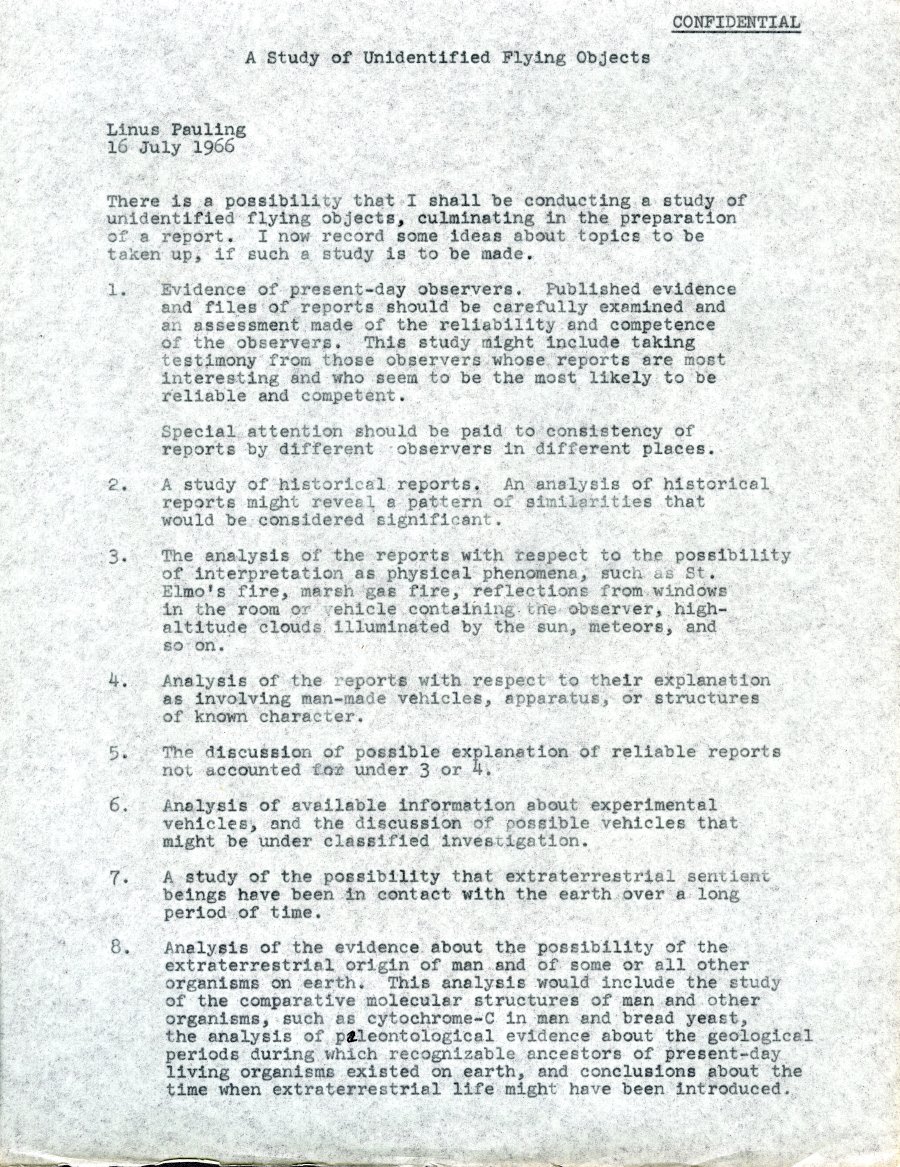
Linus went so far as to outline what a serious scientific inquiry into UFOs might look like and pondered academically switching into the field of ‘UFO Studies’ (3). He was conducting scientifically sound research in a popular field which today would label him a quack.
As sure as history is doomed to repeat itself, the ‘it’ topic of the day is what matters since we all live together in the present. So let’s embrace pop-culture and boldly go, scientifically, where no one has gone before. After all, we may one day need to know our statistically accurate chances of surviving a zombie attack.
1. ISBN: 978-1-60741-347-9 and reviewed at http://www.wired.com/wiredscience/2009/08/zombies/
2. letter written to Sterling A. Colgate in 19688: http://paulingblog.files.wordpress.com/2009/05/letter-from-lp-to-colgate-6-19-1968.jpg
3. Scan of his experimental outline: http://paulingblog.files.wordpress.com/2009/05/sci10-009-1-01-900w.jpg


No comments:
Post a Comment